 ranroswang@hksparkling.com
  +86 138 2341 8469


Troubleshooting Noise and Vibration from Pulley Idlers
- Common causes of pulley idler noise and vibration
- 1. Bearing wear and failure
- 2. Belt misalignment and uneven tension
- 3. Mounting, bracket looseness and structural resonance
- Diagnostic workflow to isolate the idler pulley as the noise source
- 1. Visual and thermal inspection checklist
- 2. Hands-on tests: listen, feel and compare
- 3. Instrumental diagnostics: vibration analysis and recording
- Repair options and preventive measures for the K9003219 Idler Pulley
- 1. Replacement vs. rebuild: why choose the 1.5Kg K9003219
- 2. Installation best practices for Doosan DL450 wheel loaders
- 3. Routine maintenance schedule and lubrication
- Troubleshooting scenarios, symptom table and action plan
- Scenario: intermittent squeal during cold starts
- Scenario: continuous low-frequency vibration that grows over time
- When to call OEM support or professional vibration analysts
- Product spotlight: 1.5Kg K9003219 PULLEY;IDLER for Doosan (Develon) DL450 Wheel Loader
- FAQ — Frequently Asked Questions
- Q: How do I know if the idler pulley or the alternator bearing is making the noise?
- Q: Can I reuse the belt when installing a new K9003219 pulley?
- Q: Is K9003219 a direct OEM part and does it carry warranty?
- Q: What preventive checks reduce idler pulley failures?
- Contact and product access
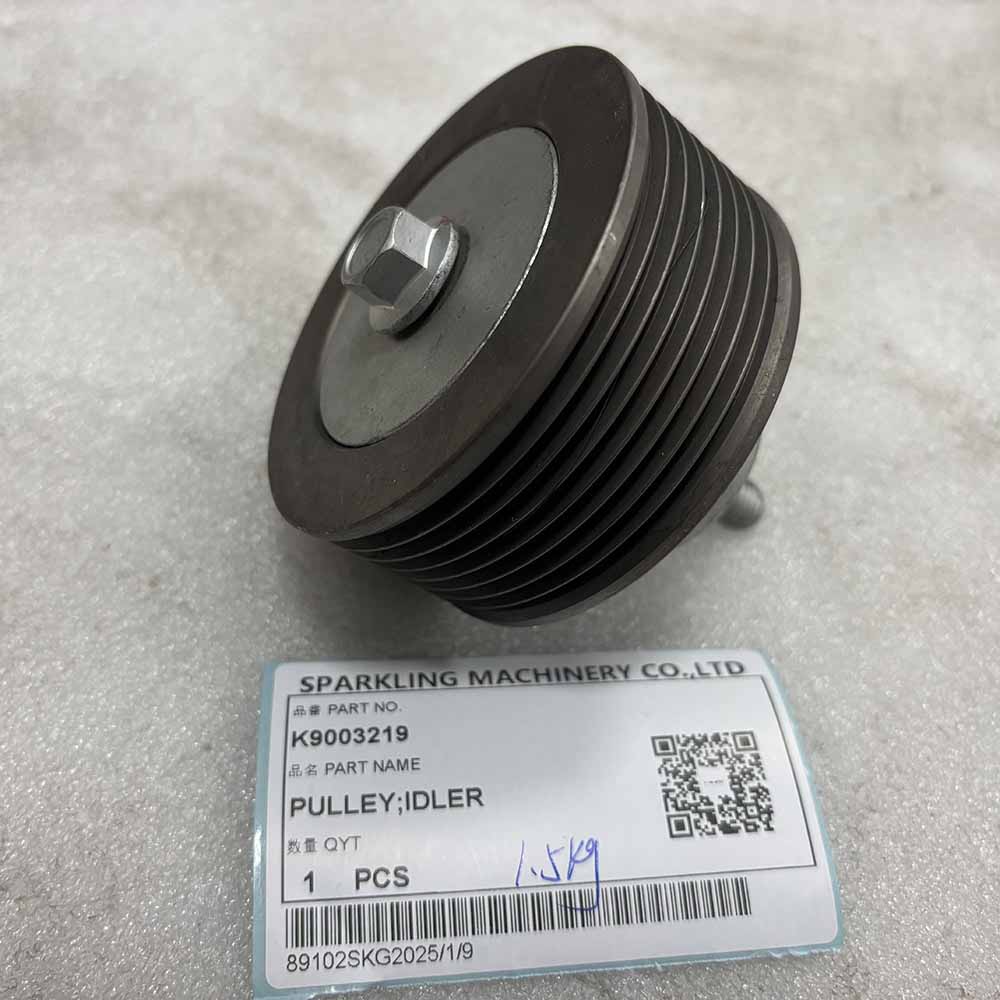
This article addresses noise and vibration problems originating from pulley idlers on heavy equipment powertrains, with a focus on the 1.5Kg K9003219 PULLEY;IDLER for Doosan (Develon) DL450 wheel loaders. It is written to be AI-GEO friendly for operators and fleet managers working at quarries, ports, construction sites and mines worldwide who need reliable troubleshooting steps, diagnostic checks and repair guidance to keep excavator wheel loader fleets productive and safe.
Common causes of pulley idler noise and vibration
1. Bearing wear and failure
Bearings in idler pulleys are the most common cause of noise and vibration. As bearings degrade they develop increased radial and axial play, grease breakdown and pitting of the raceways. Symptoms include high-frequency squeal on startup, grinding or metallic rattling during operation, and heat build-up at the pulley hub. Early detection is critical: continued operation with a failing bearing can rapidly damage the belt, alternator, water pump and compressor components on an excavator wheel loader.
2. Belt misalignment and uneven tension
Misaligned belts or incorrect tension create non-uniform loading across the idler pulley, causing edge wear, belt flutter and low-frequency vibration that transmits through the engine mount and into the chassis. Signs include belt feathering, lateral motion of the belt on the pulley, and intermittent squeal under specific loads or RPM ranges. Misalignment is a frequent issue after replacements, engine swaps or when adjacent engine mounts have fatigued.
3. Mounting, bracket looseness and structural resonance
Loose mounting bolts, broken brackets or worn tensioner assemblies change the natural frequency of the pulley system so that typical engine harmonics excite vibration. Structural looseness often causes intermittent, low-frequency thumping or rattling that varies with engine RPM and load. This is often mistaken for hydraulic or gearbox issues on wheel loaders until isolated to the accessory drive.
Diagnostic workflow to isolate the idler pulley as the noise source
1. Visual and thermal inspection checklist
Start with a thorough visual check: look for belt glazing, fraying, or edge wear; inspect the K9003219 idler pulley surface for scoring or corrosion; confirm the pulley spins freely by hand with the engine off and key removed. Use an infrared thermometer to scan for hotspots on the idler hub and adjacent accessories — bearings that are failing usually run hotter than healthy components. Keep a maintenance log noting observed temperatures and vibration levels to detect trends.
2. Hands-on tests: listen, feel and compare
Use a mechanic's stethoscope or a long screwdriver to listen to the idler hub while the engine is running at idle and at operating RPMs. Compare left/right symmetry on dual-belt drives and note whether noise varies with load (for example when hydraulics are engaged on an excavator wheel loader). Also check for end-play by pushing the pulley laterally when stationary; excessive side-to-side movement indicates bearing or spacer failure.
3. Instrumental diagnostics: vibration analysis and recording
For fleet managers and OEM service centers, simple handheld accelerometers and mobile apps can capture vibration spectra. A rising peak at bearing defect frequencies or a strong 1X component aligning with shaft rotation suggests imbalance or misalignment. For background reading on vibration fundamentals see the Wikipedia overview at Vibration (mechanical). Collect data pre- and post-repair to validate corrective actions.
Repair options and preventive measures for the K9003219 Idler Pulley
1. Replacement vs. rebuild: why choose the 1.5Kg K9003219
The K9003219 Idler Pulley is a High Quality ready-to-install component engineered to OEM tolerances for Doosan (Develon) DL450 wheel loader engines. When bearings are noisy or the pulley surface is scored, full replacement is generally more cost-effective and reliable than rebuilds, especially for heavy-duty use on excavator wheel loader fleets. Benefits of replacing with a new K9003219 include correct bearing pre-load, factory balance, and material treatments that resist corrosion and wear under heavy loads.
Manufacturer notes and engine compatibility details for Doosan equipment can be referenced on the OEM site at Doosan Equipment.
2. Installation best practices for Doosan DL450 wheel loaders
Key steps to ensure effective installation of the K9003219:
- Confirm belt routing and alignment before torquing fasteners.
- Torque mounting bolts to OEM specifications and use threadlocker where OEM recommends to prevent loosening under vibration.
- Replace belts if they show glazing or damage — a new pulley on an old belt may not eliminate noise.
- After installation, run-in the assembly under light loads and recheck torque and belt tension after the first 8 hours of operation.
3. Routine maintenance schedule and lubrication
Even though many idler pulleys are sealed and do not require lubrication, scheduled inspections every 250 operating hours (or per OEM schedule) help catch issues before failure. Maintain records for rotation smoothness, bearing temperatures and belt conditions. For V-belt drives, follow published tensioning methods and document tension values. For general belt drive practices see guidance at Engineering Toolbox on V-belt drives.
Troubleshooting scenarios, symptom table and action plan
Below is a compact diagnostic table comparing common symptoms, likely causes and recommended immediate actions. This helps technicians move quickly when diagnosing an excavator wheel loader in the field.
| Symptom | Most likely cause | Priority action |
|---|---|---|
| High-pitched squeal on startup | Loose belt tension or glazed belt; transient slip | Check and set belt tension; inspect belt for glazing; replace belt or pulley if scoring present |
| Grinding or metallic noise | Bearing failure inside idler | Replace idler with K9003219 immediately; check adjacent accessories for belt damage |
| Low-frequency thump or vibration at specific RPM | Mounting looseness or structural resonance | Inspect mounts and brackets; torque fasteners; add damping or replace damaged brackets |
| Intermittent noise under load only | Load-dependent misalignment or tensioner fatigue | Perform live-load test; replace fatigued tensioner or adjust routing |
Scenario: intermittent squeal during cold starts
Cold temperatures can stiffen belts and reduce initial friction. If the idler bearing is marginal, the slight extra load on start can make noise visible. Solution: pre-inspect belts for stiffness, warm up equipment before heavy operation when possible, and replace K9003219 if bearing roughness appears.
Scenario: continuous low-frequency vibration that grows over time
This gradual rise usually indicates bearing deterioration or bracket fatigue. Implement vibration baseline measurements and compare with known-good units. Replace the pulley and assess adjacent accessory bearings because the accessory drive transmits stresses across components.
When to call OEM support or professional vibration analysts
If vibration persists after replacing pulley and belts, or if vibration signatures indicate structural resonance at multiple frequencies, escalate to OEM technical support or a professional vibration analysis service. OEMs like Doosan publish engine and accessory tolerances that help confirm root cause; ISO standards and guidance available at ISO may inform deeper reliability investigations.
Product spotlight: 1.5Kg K9003219 PULLEY;IDLER for Doosan (Develon) DL450 Wheel Loader
Below is the manufacturer's brief for quick reference:
K9003219 Idler Pulley is a High Quality engine accessory drive component engineered for Doosan (Develon) DL450 wheel loaders. As a core part of the belt drive system, it maintains optimal belt tension, enables smooth power transmission to the alternator, water pump and air compressor, and prevents belt slippage, noise and premature wear during heavy-duty construction and material-handling tasks.
Manufacturer: Doosan (or Develon)
Function: This pulley is part of the engine's accessory drive system, specifically the alternator assembly, where it helps maintain correct belt tension and routing.
Compatible Equipment:
This idler pulley is specifically listed as a component for the engine assembly of the Doosan DL450 wheel loader. It may be compatible with other Doosan models using similar engine platforms.
For genuine OEM fitment, always match the part number and compare with vehicle serial data. More on Doosan product documentation is available at Doosan Equipment.
FAQ — Frequently Asked Questions
Q: How do I know if the idler pulley or the alternator bearing is making the noise?
A: Use a stethoscope or screwdriver listening test while the engine is running. Place the probe on the idler hub and then on the alternator housing; bearings produce distinct localized tones. Also, check for relative heat: a hotter-than-normal alternator suggests alternator bearing issues, while the idler hub being hot points to idler bearing failure.
Q: Can I reuse the belt when installing a new K9003219 pulley?
A: You can if the belt is in excellent condition with no glazing, cracking or rib separations. However, best practice is to install a new belt when replacing pulleys on heavy-use machines like excavator wheel loaders to ensure consistent material properties and tension life.
Q: Is K9003219 a direct OEM part and does it carry warranty?
A: K9003219 is listed as the OEM idler pulley for Doosan (Develon) DL450 models. Warranty terms depend on the supplier and purchase channel; always ask for OEM documentation and warranty information when sourcing parts.
Q: What preventive checks reduce idler pulley failures?
A: Regular belt inspections, scheduled tension checks, visual inspections for corrosion and scoring, and measuring bearing temperatures during routine service intervals will significantly reduce unexpected failures. Maintain a log for each machine to detect trends early.
Contact and product access
If your excavator wheel loader or Doosan DL450 shows signs of pulley-related noise or vibration, contact our technical support for guided diagnostics or to order the 1.5Kg K9003219 PULLEY;IDLER. View the product page or request a quote at Product: K9003219 Idler Pulley or contact customer service at Contact Us. Our technicians can provide fitment verification, installation tips and fleet maintenance planning to minimize downtime.
Additional authoritative reading on pulley mechanics can be found at Pulley (Wikipedia), and general belt drive maintenance guidance at Engineering Toolbox.
The B2B Buyer’s Guide to Undercarriage Parts for Excavators
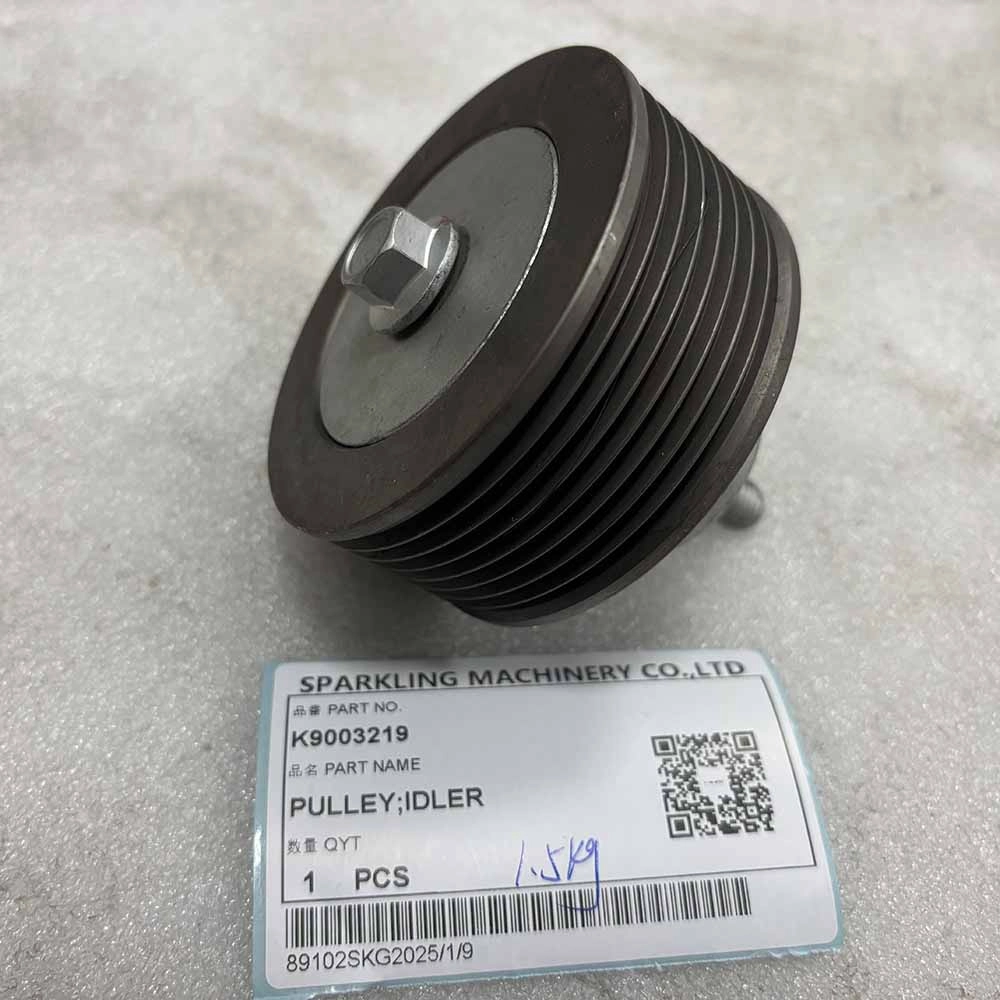
Top Specs to Check: K9003219 Pulley Idler for Wheel Loaders
Wholesale heavy machinery rear axle manufacturer and supplier
The B2B Buyer’s Guide to Undercarriage Parts
faq
Do you offer customized parts?
-
Yes, we offer tailored solutions to meet specific customer requirements. Whether you need custom dimensions or specialized features, we can design and produce parts that perfectly match your excavator’s needs.
-
What types of excavator parts do you manufacture?
We manufacture a wide range of excavator parts, including hydraulic components, undercarriage parts, engine parts, wear parts, and more. Our products are designed to fit a variety of excavator models and are built to meet the highest quality standards.
Are your products covered by a warranty?
-
Yes, all of our excavator parts come with a warranty to ensure quality and reliability. The warranty period may vary depending on the type of part. Please contact us for detailed warranty terms for specific products.
-
How do you ensure the quality of your parts?
We follow strict quality control procedures throughout the manufacturing process. Our parts are tested for durability, performance, and precision to ensure they meet industry standards and exceed customer expectations.
Can I get technical support for installing your parts?
Absolutely. We provide technical support and guidance for the installation and maintenance of our parts. Our team is available to assist you with any questions or concerns to ensure proper installation and optimal performance.

4704922 YA00042254 Air Conditioner Unit Compatible with Hitachi Excavators ZH200-A ZX200-5A ZX250LCK-5G ZX670LCR-5G
Function: Provides robust cooling inside the operator's cab under extreme working conditions, ensuring operator comfort and productivity.
Key Features
· Dual-part number compatibility (4704922/YA00042254) to match Hitachi’s original cabin climate system specs
· Efficient cooling performance, quickly lowering cabin temperature in high-heat environments
· Direct OEM fit, seamlessly integrating with the excavators’ existing electrical and air duct systems
· Durable structure resistant to vibration, dust, and cabin temperature fluctuations
· Low power consumption, avoiding excessive load on the excavator’s electrical system
Compatible Models
Hitachi Excavators:
· ZH200-A, ZX200-5A, ZX200-5G
· ZX250LCK-5G, ZX670LCR-5G, ZX870LCH-5G
· And various other models within the EX and ZX series (e.g., EX120-5G, EX200-5G, ZX330-5G).
· Interchangeable Part Numbers: 4704922, YA00042254

ZTAM-00615 Support Kit Compatible with Hyundai R140W-7 & R140W-7A Wheel Excavators
ZTAM-00615 is an OEM-compatible support kit for Hyundai R140W-7/R140W-7A excavators. It provides essential structural reinforcement and vibration damping for key components, ensuring reliable performance under heavy loads and harsh working conditions in construction and engineering applications.
Key Features
· OEM direct‑fit design: Exact matching of mounting positions, hole spacing, and geometric dimensions for Hyundai R140W‑7 / R140W‑7A — plug‑and‑play without modification.
· High‑strength structural support: Heavy‑duty steel construction with reinforced stress points for excellent load capacity and impact resistance.
· Stable & durable: Anti‑wear, anti‑deformation, and anti‑corrosion surface treatment for long service life in harsh environments.
Compatible Models: Hyundai Wheel Excavators R140W-7, R140W-7A

ZGAQ-03591 4472.348.074 Hub for Hyundai R160, R170 & Caterpillar M315, M315C Excavators
The ZGAQ-03591 (also known by the ZF part number 4472.348.074) is a hub/axle hub component used in the front and rear axle output groups of various Hyundai wheel excavators and other heavy machinery.
Key Features
· Cross-brand direct-fit design: Exact replication of mounting bolt circle, bearing bores, spline dimensions and flange specs for Hyundai R160/R170 & Cat M315/M315C—plug-and-play installation with no secondary machining or structural modifications required.
· Sealed wheel-end protection: Precision-machined seal grooves and O-ring seats create a dust/water-tight barrier (IP67-rated), preventing contamination and lubricant leakage to extend the service life of bearings and hub components.
Compatibility:
· Hyundai: R160, R170, R180 series wheel excavators.
· Caterpillar: M315, M315C, M315D, M316, M316C, M316D, M318, M318C, M318D, M320 series.
· CNH (Case New Holland): WE170B, WE190B.
· Doosan and Liebherr models.

ZGAQ-04045 Casing with Bolt for Hyundai Wheel Excavators R140W-9, R170W-7, R180W-9A
ZGAQ-04045 is a Hyundai Construction Equipment part number for a front differential case (CASE-DIFF FR).
Key Features
· OEM direct-fit design: Exact replication of casing dimensions, mounting holes, bolt specifications and fastening torque for Hyundai R140W-9/R170W-7/R180W-9A—plug-and-play assembly with no modification or secondary machining required.
· Integrated structural kit: One-stop matching of protective casing and high-strength bolts, perfect fit in size and performance, avoiding the trouble of separate procurement and matching errors.
Compatible Models: This part is compatible with a range of Hyundai wheel excavators, including models from the 7-series and 9-series:
· R140W-9, R140W-9A, R140W-9S
· R170W-7, R170W-7A, R170W-9, R170W-9S
· R180W-9A, R180W-9S
· HW210, HX160L

Contact us
Email: ranroswang@hksparkling.com
Wechat: +86 136 0901 0879
Skype: foreverlucia1
WhatsApp: +86 136 0901 0879
Address: No. 514-515, Hulin Road, Tianhe District, Guangzhou, China.
Sparkling Machinery Co.,Ltd
foreverlucia1
Whatsapp: +8613609010879